When Movies Found Their Voices: A Short Background to Sound Film
Sound film changed how stories use speech, music, and silence. Learn to spot how synchronized audio directs attention and reshapes what viewers infer.
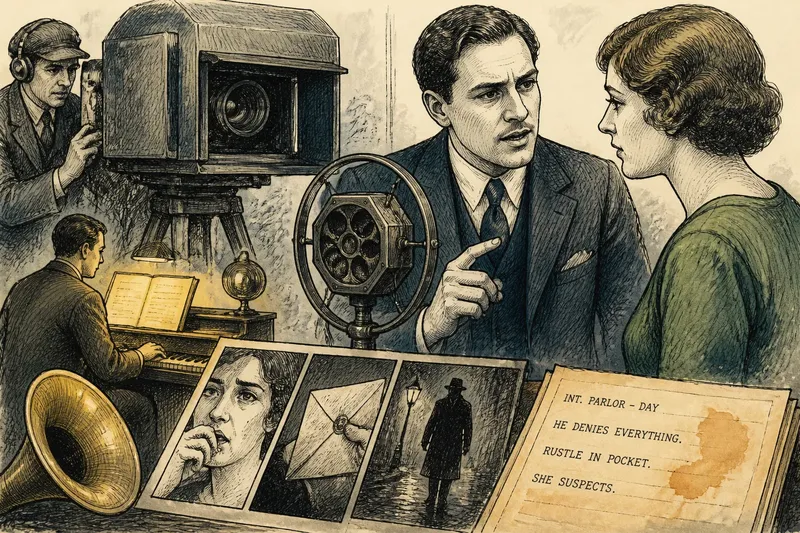
Sound film changed how stories use speech, music, and silence. In a scene, a character can deny knowing about a letter while a faint rustle draws attention to the pocket where it is hidden. The voice and the sound do not merely accompany the image; together, they shape what a viewer suspects.
What did silent films use instead of synchronized speech?
“Silent” is a convenient label, but it does not always describe the screening experience. Depending on the film and venue, a screening might include live music, recorded accompaniment, or a spoken explanation. Intertitles—written cards placed between images—could present dialogue or supply information.
Without synchronized recorded speech as a regular part of the film, storytellers arranged meaning through images, gestures, editing, music, and text. A raised eyebrow could suggest suspicion. A cut to a letter could reveal a plan. An intertitle could deliver a line that would be awkward to convey through gesture alone.
These methods did more than stand in for dialogue. An intertitle could interrupt an image to clarify a fact, while a close view of a hand might leave a motive uncertain. Music could shape a scene’s mood without identifying the source of a sound.
Why did synchronized sound change how films were made?
When dialogue and other sounds could be recorded in relation to the image, a scene could carry information through several channels. One character might speak while another reacts silently. A sound from beyond the frame could suggest activity elsewhere. Viewers could follow a story through speech, expression, and the acoustic world around the characters.
Early sound recording also brought practical constraints. Equipment and microphone placement could limit movement, while unwanted noise could interfere with a take. Some productions used soundproof camera enclosures to reduce camera noise, a setup that could restrict camera movement. The exact methods and effects varied by production, so it is better to treat these as possible pressures than as rules that applied to every early sound film.
Those pressures could affect style. A scene might keep the camera relatively still while actors moved within the usable recording area. Dialogue could take up more of a scene, and conversation might replace information once conveyed through gesture or an intertitle. The transition was gradual: filmmakers continued to use established visual methods while experimenting with synchronized sound.
What could dialogue communicate that images could not?
Speech made certain kinds of storytelling easier to stage. Characters could argue over a complicated decision, describe an event elsewhere, or expose a difference between what one person believes and what another does. Accents, hesitations, and interruptions could help shape relationships without stopping for explanatory text.
A character’s speech could also suggest a region, profession, or social position. Those cues may add texture, but they can also steer how viewers judge a character. A voice is not neutral simply because it is heard rather than read. Who speaks, how they sound, and whose words the story treats as authoritative all shape its point of view.
Dialogue does not automatically reveal the truth. A character can lie, dodge a question, or say very little. Listen for the relation between speech and action: does a promise match the speaker’s behavior, or does the scene invite you to distrust the words?
How did acting change when audiences could hear performers?
Silent-era performers worked with a vocabulary built for visual legibility. Gestures and expressions needed to read clearly on screen. With synchronized dialogue, breath, timing, pitch, and vocal texture became additional parts of a performance.
That did not make acting smaller or more natural by definition. A broad gesture could still suit a comic scene; a carefully shaped line could be just as stylized. A pause before an answer might carry tension, while a quiet reply could complicate a composed expression.
The voice also changed the relationship between a performer’s body and the character. Some performers adapted to the new demands; others encountered different challenges in delivery and recording. It is too simple to reduce the transition to a story of talent succeeding or failing: the medium and its production conditions were changing too.
How did music and effects reshape a scene?
Sound film was never only about dialogue. Music could be tied closely to a scene or shift in mood. Effects could make a setting feel inhabited: footsteps in a corridor, a train heard before it appears, or a door closing after someone leaves.
Sound could also expand the frame. A voice from another room might pull attention away from the person on screen. A rumble could suggest a passing vehicle without showing it. Silence—or the sudden absence of an expected sound—could make a familiar setting feel uncertain.
Sound design creates choices about emphasis. If every movement receives a conspicuous effect, a scene may feel busy. If the soundtrack stays selective, a small noise can stand out. There is no need to hunt for a hidden clue in every creak; ask instead what the soundtrack directs you to notice and whether that changes how you read the action.
What do viewers ask about early sound film?
Why can an early sound scene feel stage-bound?
A relatively fixed camera or concentrated dialogue may reflect recording constraints, a deliberate focus on performance, or both. Notice whether the stillness helps you follow the exchange or makes the action feel confined.
Did intertitles vanish when synchronized dialogue arrived?
No. Written text could still identify a location, mark a time shift, or show information characters did not need to say aloud. Compare what the film gives you through text with what it conveys through speech and image.
How can a voice change the meaning of a face?
Listen for a mismatch between expression and delivery, such as a smile paired with a strained voice. That contrast can make a character seem guarded or less certain than the image alone suggests.
Should viewers treat every technical limit as a flaw?
No. A constraint can shape a scene without making it unsuccessful. Notice what the filmmakers accomplish with the choices available in that particular scene rather than judging it only against later techniques.
How can you compare silent and sound scenes?
Choose two scenes with a similar dramatic task, such as hiding information or persuading another character. Watch each without pausing. Then replay them and note where the story places its information: in an intertitle, gesture, spoken line, reaction, or offscreen sound.
Say you choose an imagined silent scene in which a clerk slips a folded note into a coat, followed by an imagined sound scene in which a character denies knowing about the note as paper rustles nearby. First, write down what the silent scene lets you see: the note enters the coat, but the clerk’s motive remains open. Next, note what the sound scene adds: the denial and rustle invite suspicion, though neither proves the character’s knowledge. The comparison shows a tradeoff: the first scene leaves more for gesture-based inference, while the second gives speech and sound a role in shaping doubt.
As voices enter a film, notice both what they add and what they displace. Dialogue can clarify a motive, but it can also leave less room for inference. Music can deepen a mood, yet it can also steer your response. Sound film’s lasting contribution was another way to distribute knowledge, direct attention, and leave viewers weighing which signal to trust.