The Hidden-Meaning Trap: Not Every Detail Is a Clue
Learn to separate grounded film interpretation from guesswork by checking repetition, context, and story consequences before assigning meaning to a detail.
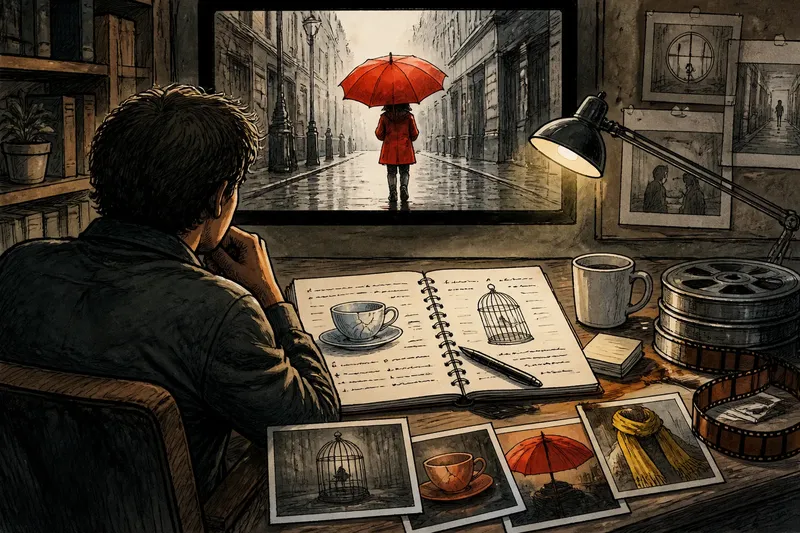
A red umbrella appears behind the lead in one shot, and suddenly it seems to mean danger, childhood, or a secret the film has not revealed. That leap is the hidden-meaning trap: treating every visible detail as a clue before asking what the movie actually does with it.
Film interpretation needs curiosity, but curiosity is not the same as certainty. A useful reading begins with what is on screen, tests how the detail behaves across the story, and leaves room for the possibility that a red umbrella is simply an umbrella. The aim is not to drain films of mystery. It is to tell a supported interpretation from an attractive guess.
What makes a detail feel meaningful?
Movies place objects, colors, gestures, and sounds in front of us through deliberate choices. That can make any detail feel selected for a reason. But a movie’s frame is also full of practical necessities: a room needs furniture, a street needs signs, and a character’s coat needs somewhere to hang. A visible object may be chosen, borrowed, reused, or simply available without carrying a story-level message.
Meaning becomes more plausible when a detail connects to the film’s broader organization. Does it recur at moments that change the character’s understanding? Does another scene draw attention to it? Does it relate to a conflict the film has already established? Those links matter more than the object’s potential symbolism in isolation.
Consider a cracked teacup. It could suggest a damaged family, but that reading has little support if it appears once among many kitchen items and never affects a scene. If a character repeatedly chooses that cup, another person asks why it has not been thrown away, and its eventual absence changes a familiar routine, the interpretation has firmer ground. The cup’s meaning emerges from its use in the story, not from a symbol dictionary.
How can you test a reading without killing the fun?
Start with an observation you could point to, then separate it from the interpretation you are proposing. “The cup is chipped and appears in three breakfasts” describes evidence. “The cup represents the family’s unresolved grief” is an interpretation. Keeping those statements distinct makes it easier to see what the film supports and what you are adding.
Then ask what would make the interpretation stronger or weaker. A repeated object can gain force through changes in who handles it, where it appears, or what happens around it. A detail that never returns, receives no emphasis, and has no visible consequence may still prompt a personal association, but that association should not be mistaken for the film’s established design.
One useful question is: if this detail were removed, what would change? The answer need not be a major plot turn. Perhaps the scene would lose a visual echo, a character would have no reason to pause, or a later action would become harder to understand. If nothing in the scene or story seems altered, the detail may not be doing much narrative work.
That test has limits. A film can use a single detail quietly, and viewers can miss a connection on a first watch. The point is not to reject subtlety. It is to keep a claim proportional to its evidence: “This might echo the character’s fear” is more accurate than “The filmmakers definitely meant this object to symbolize fear” when the movie offers only a faint link.
Where does interpretation outrun the evidence?
A common slip is to treat resemblance as proof. A round window resembles an eye, so a viewer decides the house is watching the characters. A color recalls a familiar genre convention, so the color must carry that convention’s meaning here. Resemblance can suggest a question; it cannot answer the question on its own.
Another slip is to treat every repeated element as a code. Repetition can be meaningful, but it can also come from continuity, a recurring location, or the ordinary rhythm of a scene. Look for variation as well as recurrence. If a yellow scarf appears in several scenes, does its role change with the character’s choices, or is it simply part of a costume that remains consistent?
Intentionality is also not all-or-nothing. A production designer may choose an object because it suits a room, while a director later frames it in a way that gives it emotional weight. A performer may handle a prop casually, yet that gesture can become significant in the finished scene. The film’s effect can support an interpretation even when a viewer cannot establish exactly which crew member intended it.
And not every useful interpretation needs to uncover a hidden message. A detail can shape mood, make a setting feel lived in, or keep a scene visually coherent. Those are real functions. Calling them symbolic may add a layer the film has not earned.
How do you distinguish grounded interpretation from a guess?
What counts as evidence for a symbol?
Look for a pattern that the film makes perceptible: repetition with variation, emphasis through dialogue or action, or a clear connection to an established conflict. A single striking object can support a reading, but the claim should remain modest unless other parts of the film reinforce it.
Does a detail need to recur to matter?
No. A one-time detail may carry meaning if the scene gives it unusual emphasis or makes it consequential to a character’s choice. Recurrence is helpful evidence, not a rule that every meaningful detail must satisfy.
How can you tell symbolism from background decoration?
Ask whether the detail affects attention, action, mood, or story comprehension, and whether the film connects it to anything beyond its first appearance. Decoration can still enrich a scene, but a decorative object does not automatically become a coded message.
What if two readings both seem plausible?
Compare how well each reading explains the film’s observable choices without requiring extra assumptions. If both remain possible, keep both as interpretations rather than declaring one the hidden answer.
What does a careful reading look like in practice?
Say you notice a small birdcage in a character’s apartment. It appears in the opening scene, where the character avoids looking at it, and later, when a visitor opens the cage door. You might read it as a sign of restricted freedom. Before settling on that idea, check whether the film links the cage to the character’s choices, whether the visitor’s action changes the relationship, and whether the bird or cage returns in a way that develops the conflict.
If those connections are present, the reading has a chain of support: the cage is visible, characters respond to it, and those responses connect to the story’s concerns. If the cage vanishes and nothing else points toward confinement, the interpretation may still be personally resonant, but it is less securely grounded. The careful viewer can enjoy the association while naming that distinction.
This approach is especially useful after a first viewing, when a memorable image can feel more decisive than it is. Jot down the detail and the scene where it appears. Later, compare it with other moments rather than letting memory turn one image into a pattern. A brief note such as “birdcage, character looks away” preserves the observation without prematurely locking in its meaning.
What is not worth the effort? Trying to assign a fixed symbolic meaning to every prop, color, or shape. That turns viewing into a scavenger hunt and can make ordinary production choices seem like secret messages. Keep the question open instead: what does this detail do here, and what in the film supports that answer?
Why leave room for uncertainty?
A film’s meanings are not always sealed into a single solution. One viewer may connect a recurring object to grief, while another sees a sign of habit or class. Their readings can differ and still be thoughtful if each points to specific moments and explains the connection. Interpretation becomes less convincing when it treats personal association as evidence everyone must accept.
Uncertainty also protects the pleasure of discovery. When you notice a possible echo, you can follow it through the film without demanding that it resolve into a definitive code. Sometimes the pattern strengthens. Sometimes it dissolves into the texture of a believable room. Both outcomes tell you something about how the film holds your attention.
The next time a background object seems to whisper a secret, pause on the scene and separate what you saw from what you inferred. Then look for repetition, emphasis, and consequence. That simple distinction keeps film criticism alert to detail without asking every lamp, photograph, or teacup to explain the whole story.