A Two-Film Evening Built Around One Story Question
Plan a two-film evening around one character-choice question, then use a short pause to compare how each story answers it without forcing a verdict.
Choosing two films for a shared question about character choice can turn an ordinary movie night into a lively conversation. Start with a question such as, “When does loyalty become a refusal to change?” Then choose films whose characters face meaningfully different versions of that dilemma. The point is not to crown one story correct. It is to notice what each film makes a choice cost.
What makes a good question for two films?
A useful story question is open enough for two different answers, but specific enough to guide what you watch. “What makes a good person?” sprawls across too many themes. “Can someone protect a friend without hiding the truth?” gives you a conflict you can follow through scenes, decisions, and consequences.
Keep the question focused on a character’s choice, not a plot detail or a hidden message. Ask what a person should do, what they owe someone, or what they are willing to risk. Questions about loyalty, forgiveness, ambition, honesty, duty, and belonging offer plenty of room for contrasting stories.
- Make the choice visible. The character should face an action they can take or refuse, rather than a vague mood.
- Leave room for disagreement. If the wording already tells viewers which choice is right, the conversation has nowhere to go.
- Keep the scope manageable. One moral tension is easier to compare than a bundle of themes.
- Make it relevant to both films. The stories can differ in setting and genre, but each needs a real decision connected to the question.
Try phrasing the question as a tension: “Is it kinder to tell a painful truth or preserve a comforting lie?” That wording points toward a decision while leaving the answer open. Avoid a question so broad that you could discuss nearly any film without referring to its actual story.
How do you choose films that answer it differently?
Look for contrast in the circumstances around a choice, not just contrast in genre or mood. Two films about honesty may offer little to compare if both characters face the same pressure and reach similar outcomes. A stronger pairing gives each character a distinct reason to act and distinct consequences to face.
One story might frame honesty as a risk to a friendship; another might show what secrecy does to a group that depends on trust. The shared question holds the pair together, while the different stakes make the answers worth comparing. You do not need films from the same country, period, style, or series.
Before settling on a pair, check reliable plot descriptions or your own memory for the central choice. Keep those checks brief; reading a detailed synopsis can reveal turns you would rather encounter onscreen. If you already know both films, write down the decision each protagonist faces without writing down the ending. That gives you a clear reason for the pairing while protecting the viewing experience.
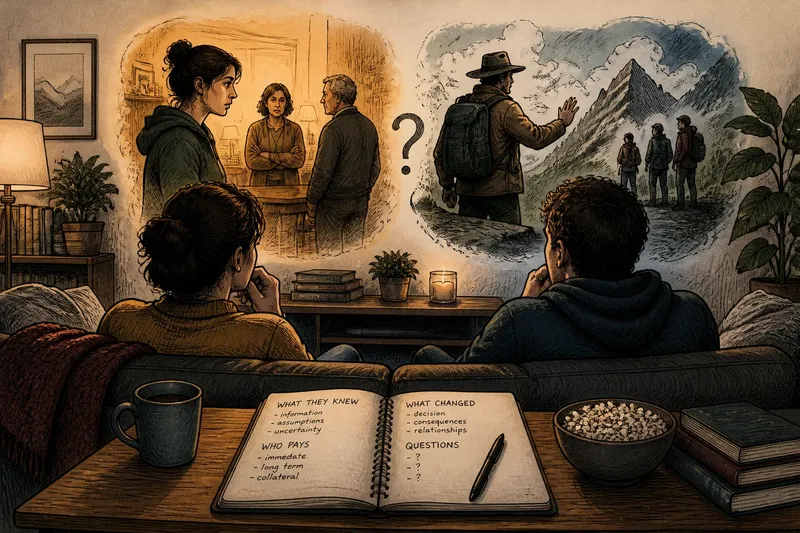
Say you want to explore, “When should someone break a promise?” You might pair an invented family drama, in which a young adult considers exposing a relative’s harmful secret, with an invented adventure story, in which a guide must choose between keeping a promise and warning a traveling party. The settings differ, but both stories make a promise collide with responsibility. During the pause, you can compare who bears the risk, what the character knows, and which consequences the story leaves visible.
What should you notice while watching the first film?
Watch the story before you start building a verdict. Notice when the choice becomes clear, what information the character has, and who else will be affected. A person who acts with incomplete knowledge may face a different moral problem from someone who sees the likely consequences and proceeds anyway.
Pay attention to how the film presents the decision. Does the character have time to think, or must they respond under pressure? Can they discuss the problem with someone, or are they isolated? Those circumstances shape how an action feels without automatically making it right.
You do not need to take notes throughout. If you want a record, jot down a few words after a turning point: “what they knew,” “who pays,” or “what changed.” Small prompts are easier to revisit than a running plot summary, which can pull your attention away from the film itself.
How long should the pause between films be?
Long enough to reset your attention, but short enough to keep the comparison fresh. A break for a drink, a stretch, or a few written notes is usually more useful than launching straight into a debate as the credits end. Let the first film settle before you reduce it to a position in an argument.
Use the pause to record observations, not to decide which story wins. Write down the character’s choice, the strongest reason for it, and one consequence the film emphasizes. Add a question mark beside anything you are unsure about. That uncertainty can become the most interesting part of the discussion.
Keep your notes selective. A few concrete details—a conversation the character avoids, a promise they repeat, or the moment they finally act—will help you recall the story. It is not worth the effort to catalog every symbol, line, or plot turn; the shared question is your guide, not a scavenger hunt.
How can you compare the films without picking a winner?
After the second film, compare the conditions behind each decision before comparing the decisions themselves. Ask what each character knew, what alternatives seemed available, and who had to live with the result. Then ask how the story responds: does it affirm the choice, complicate it, or leave its consequences unresolved?
Separate a character’s action from the film’s judgment of it. A story may show a decision as understandable without presenting it as wise. Another may deliver a tidy resolution while leaving practical or emotional costs in view. Looking at that distinction helps you discuss what the film suggests without treating every event as a verdict.
Keep the conversation anchored in particular scenes. If someone says, “The second character was more selfish,” ask which moment supports that reading and what the character could see at the time. Another viewer might point to a detail that changes the interpretation. Specific evidence makes disagreement more generous and more interesting.
Which story question should you try next?
Can a person change without apologizing?
Choose two films in which a character tries to move beyond past behavior, but each story treats accountability differently. Compare what the character does to repair harm with what other people are asked to accept.
Does protecting someone mean keeping a secret?
Pair stories where silence shields someone in the short term but may affect other people. Notice who gets to decide what protection means and who carries the consequences of that decision.
When does ambition become betrayal?
Look for characters whose pursuit of a goal changes a relationship or obligation. Compare what each person believes the goal is worth, then consider whose view the story asks you to take seriously.
Is forgiveness owed, or freely chosen?
Choose films that give the injured person different amounts of time, power, or support. Ask whether either story treats forgiveness as a gift, a demand, or a shortcut around repair.
What if the films seem to give the same answer?
A shared answer can still make a strong pair if the stories reach it by different routes. One character might change after hearing a direct appeal; another might learn through the consequences of a choice. Compare what persuades them and what each film suggests has to happen before change becomes possible.
You may also find that the films disagree less about the choice than about the cost. Both might favor honesty, for example, while one emphasizes a damaged relationship and the other stresses the burden of carrying a secret. A good comparison does not need opposite conclusions; it needs differences you can point to in the story.
To plan a two-film evening around one story question, choose a clear character dilemma, select films that give it distinct stakes, and leave space between them to capture a few observations. In the conversation afterward, return to what each character knew, what alternatives they had, and what the story made visible. The most useful question may be the one the films leave you debating on the way home.